
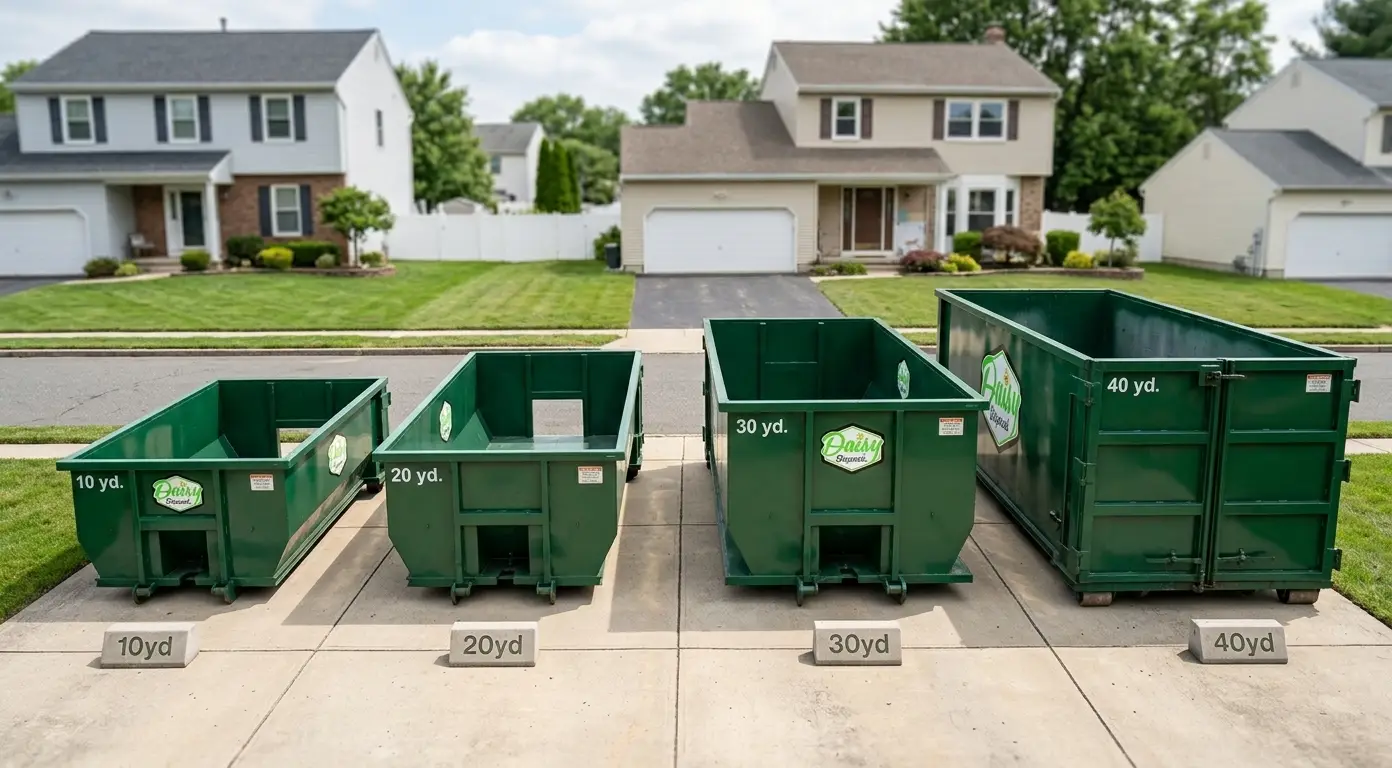
Dumpster size is measured in cubic yards, but the number on a quote doesn’t tell you how much physical space a container actually takes up on your property. Two dumpsters with the same cubic-yard rating can have different lengths, widths, and heights depending on the provider , a detail that matters when you’re planning delivery around a driveway, gate, or overhead line. Daisy Disposal offers 10, 20, 30, and 40 yard roll-off dumpsters, and this guide breaks down the actual dimensions, capacity, and space requirements for each size , not which one to rent for a specific project.
If you already know your project type and just need help picking a size, that decision is covered in our guide on choosing the right dumpster for your project. This article focuses specifically on the physical side of the equation: how big each container actually is, and whether one will fit where you need it placed.
Quick Summary
- Dumpster capacity (cubic yards) and physical dimensions (length, width, height) are two different measurements.
- A 20-yard dumpster is roughly 22 feet long, 8 feet wide, and 4.5 feet high – but exact dimensions vary by provider.
- Larger sizes (30 and 40 yard) need more overhead clearance due to taller side walls, not longer footprints.
- Always confirm actual dimensions with your provider before delivery, especially on tight driveways or limited-access properties.
Dumpster Sizes at a Glance
| Dumpster Size | Typical Capacity | Approx. Length | Approx. Width | Approx. Height | Pickup Truck Loads | Physical Considerations |
| 10 Yard | 10 cubic yards | ~12–14 ft | ~7–8 ft | ~3.5 ft | ~4 loads | Fits most driveways, low profile |
| 20 Yard | 20 cubic yards | ~22 ft | ~8 ft | ~4.5 ft | ~8 loads | Standard driveway width usually works |
| 30 Yard | 30 cubic yards | ~22 ft | ~8 ft | Taller side walls than 20-yard | ~12–14 loads | Needs more overhead clearance |
| 40 Yard | 40 cubic yards | Similar footprint to 30-yard, taller | ~8 ft | Tallest standard option | ~16 loads | Largest overhead clearance requirement |
Exact measurements vary by container and provider — confirm with Daisy Disposal before booking if your placement space is tight or unusually shaped.
10 Yard Dumpster Dimensions
A 10-yard dumpster is the smallest standard roll-off size, generally running about 12–14 feet long, 7–8 feet wide, and roughly 3.5 feet high. Its low profile and compact footprint make it the easiest size to place on most residential driveways without needing extra clearance planning or a wide approach path.
In terms of debris capacity, a 10-yard dumpster holds around 10 cubic yards of material , roughly the equivalent of 4 pickup truck loads. Because of its smaller footprint, it’s often the only size that comfortably fits on narrow driveways, shared driveways, or properties with limited side-yard access. Its low height also means overhead clearance is rarely a concern, even under moderately low tree canopy.
20 Yard Dumpster Dimensions
The 20 yard dumpster dimensions typically run about 22 feet long, 8 feet wide, and 4.5 feet high. In terms of 20 yard dumpster dimensions in feet, this size holds roughly 20 cubic yards of debris , about 8 pickup truck loads.
Its footprint is significantly longer than the 10-yard but similar in width, so it generally still fits on a standard-width driveway. Because it’s longer, delivery trucks need a straighter approach path rather than a tight turn to place it accurately , something worth checking on curved or short driveways before booking. The added height compared to a 10-yard is modest, so most residential properties won’t run into clearance issues at this size.
30 Yard Dumpster Dimensions
The 30 yard dumpster length is typically similar to the 20-yard at around 22 feet, but with noticeably taller side walls. This added height is what gets the capacity up to roughly 30 cubic yards – about 12 to 14 pickup truck loads – without significantly increasing the ground footprint.
Because of the taller walls, overhead clearance becomes a more important factor at this size. Low tree branches or power lines that wouldn’t affect a 10- or 20-yard delivery can become a real obstacle with a 30-yard container. It’s worth walking the delivery path and checking vertical clearance before scheduling, particularly on older properties with mature trees.
40 Yard Dumpster Dimensions
The 40-yard dumpster is the tallest standard roll-off option, holding around 40 cubic yards , roughly 16 pickup truck loads. Its footprint is comparable to the 30-yard in length and width, with the added capacity coming primarily from height rather than a longer container.
This makes overhead clearance the single biggest placement factor for a 40-yard container. It’s most commonly used for commercial projects, large-scale demolition, and warehouse cleanouts, where both the ground space and overhead clearance are typically pre-planned as part of a larger project layout. Residential properties can still use a 40-yard, but it’s worth confirming clearance carefully given its height.
How Much Space Does a Dumpster Need?
Placement space depends on more than the dumpster’s footprint alone – the surrounding access path matters just as much as the container itself. Before delivery, check the following:
1- Driveway width — most sizes need roughly 10–12 feet of clear width for safe placement and truck maneuvering.
2- Truck access — delivery trucks generally need a straight approach; tight turns or narrow side entrances can rule out longer containers even if the parking spot itself is wide enough.
3- Overhead clearance — taller dumpsters (30- and 40-yard) need more vertical room away from trees and power lines than shorter containers do.
4- Gates and fences — a narrow gate opening can block delivery even when the driveway behind it is wide enough for the container.
5- Ground and surface conditions — a flat, stable surface is required for safe placement; soft ground, loose gravel, or a sloped driveway can shift under a loaded container.
6- Street placement — placing a dumpster on a public street instead of a private driveway may require a local permit, and clearance rules can differ from driveway placement.
Measuring twice before delivery day is the simplest way to avoid a rescheduled drop-off.
Dumpster Capacity vs. Physical Dimensions
Dumpster capacity refers to how much volume a container holds, measured in cubic yards. Physical dimensions refer to the container’s actual length, width, and height. These two measurements are related but not interchangeable; a taller, shorter container can hold the same capacity as a longer, lower one, depending on how the manufacturer designed it.
This is exactly why two 20-yard dumpsters from different providers can have different footprints even though both hold 20 cubic yards of material. Capacity tells you how much debris will fit inside; dimensions tell you whether the container will physically fit on your property. When you’re comparing quotes or providers, both numbers deserve equal attention , a container that’s the right capacity but too long for your driveway isn’t actually a good fit.
How Many Pickup Truck Loads Fit in Each Dumpster?
| Dumpster Size | Approximate Pickup Truck Loads |
| 10 Yard | ~4 loads |
| 20 Yard | ~8 loads |
| 30 Yard | ~12–14 loads |
| 40 Yard | ~16 loads |
These figures are a general guide based on average pickup truck bed capacity. Dense materials like concrete, brick, or shingles will hit a dumpster’s weight limit before matching these volume equivalents, so heavy debris projects should factor weight limits in alongside these load comparisons.
Do Dumpster Dimensions Vary by Provider?
Yes. There is no single universal physical dimension for every dumpster labeled “20-yard” or “30-yard” . Cubic-yard capacity is fairly standardized in concept, but the actual length, width, and height can differ between companies depending on how each container is manufactured. A 20-yard dumpster from one provider may be longer and lower than another provider’s 20-yard container with the same rated capacity.
Because of this, it’s worth confirming actual dimensions before booking, especially if your placement space is tight, oddly shaped, or has limited clearance. Daisy Disposal can confirm the exact dimensions and placement requirements for the specific container you’re renting, so you’re not relying on generic industry averages when planning your delivery.
What Is a Standard Dumpster Size?
There is no single universal standard dumpster size. Roll-off dumpsters are commonly available in 10, 20, 30, and 40 yard capacity options, and these four sizes function as the industry’s standard range , but the physical dimensions behind each capacity number aren’t fixed across every provider. When people search for “standard dumpster size,” they’re usually referring to this common 10-to-40-yard range rather than one fixed set of measurements.
How to Check if a Dumpster Will Fit Your Property
- Measure the available placement area, including both length and width where the container will sit.
- Check driveway width against the dumpster size you’re considering, allowing extra room for truck maneuvering.
- Check overhead clearance, particularly if you’re considering a 30- or 40-yard container.
- Confirm delivery truck access — trucks generally need a straight approach path rather than a sharp turn.
- Note any gates, fences, trees, or utility lines that could block placement or limit the approach.
- Confirm the dumpster’s actual dimensions with your provider rather than assuming generic industry figures.
- Confirm placement requirements with Daisy Disposal before your scheduled delivery date to avoid last-minute changes.
Dumpster Dimensions for Residential vs. Commercial Properties
Residential properties typically place dumpsters in driveways, which brings a specific set of constraints:
1- Driveway width is usually the primary limiting factor.
2- Narrow or gated access can rule out certain sizes regardless of capacity needed.
3- Overhead clearance from trees or low wires needs to be checked before booking.
4- Some HOAs or local ordinances restrict placement location, duration, or require a permit for street placement.
Commercial properties generally have more flexibility for larger containers:
1- Dedicated loading areas or lot space accommodate larger footprints without driveway constraints.
2- Warehouse and construction-site access is typically built for truck delivery already.
3- Placement areas are generally larger, making 30- and 40-yard containers easier to accommodate.
4- Frequent delivery and pickup cycles are easier to manage with pre-planned, dedicated space.
Compare Dumpster Dimensions Before You Rent
Before booking, compare containers across capacity, length, width, height, required placement space, delivery access, and weight limitations , not just the cubic-yard number on the quote. A dumpster that’s the right capacity but the wrong footprint for your property isn’t actually the right fit, and finding that out on delivery day is the most common and most avoidable scheduling headache in dumpster rental.
Daisy Disposal can walk through exact dimensions and placement requirements for your property before you book, so there are no surprises when the truck arrives.
Frequently Asked Questions About Dumpster Dimensions
What are the standard dumpster dimensions?
There’s no single universal dimension for each size – 10, 20, 30, and 40 yard are the standard capacity options, but exact length, width, and height can vary by provider.
How big is a 10 yard dumpster?
A 10-yard dumpster is typically about 12–14 feet long, 7–8 feet wide, and 3.5 feet high, holding around 10 cubic yards of debris.
What are the 20 yard dumpster dimensions?
A 20-yard dumpster typically measures about 22 feet long, 8 feet wide, and 4.5 feet high, holding roughly 20 cubic yards.
What are the 30 yard dumpster dimensions?
A 30-yard dumpster is typically similar in length to a 20-yard, around 22 feet, but with taller side walls that increase capacity to roughly 30 cubic yards.
How big is a 40 yard dumpster?
A 40-yard dumpster has a footprint similar to a 30-yard but with greater height, holding around 40 cubic yards of debris.
How much space does a dumpster need?
Most sizes need roughly 10–12 feet of driveway width, a straight truck approach, and enough overhead clearance to avoid trees and power lines.
Do dumpster dimensions vary by company?
Yes. Cubic-yard capacity is fairly standardized, but the actual length, width, and height of a dumpster can differ between providers even at the same rated size.
What is the largest standard roll-off dumpster?
The 40-yard dumpster is the largest standard option, typically holding around 40 cubic yards of debris.
How much can a 20 yard dumpster hold?
A 20-yard dumpster holds roughly 20 cubic yards of debris, equivalent to about 8 pickup truck loads.
What is the difference between dumpster size and dumpster capacity?
Dumpster size often refers to physical dimensions – length, width, and height – while capacity refers to volume in cubic yards. Two dumpsters can share the same capacity but have different physical dimensions.